The bill nobody shows you before the sale
A mechanical watch has a running cost. Across twenty years it is often a quarter of the purchase price, and it is entirely predictable.
At a glance
- Interval
- Five to seven years for a modern automatic
- Mainstream service
- 600 to 900 at a good independent
- Complicated or house movement
- 900 to 1,800, sometimes considerably more
- Twenty year total
- Three services, so 1,800 to 5,400
Everything mechanical that runs continuously needs maintenance, and a watch runs continuously for years at a time with lubricants measured in fractions of a milligram. The service is not optional in the long run. It is simply presented after the purchase, when the enthusiasm has been converted into a possession.
What a service actually is
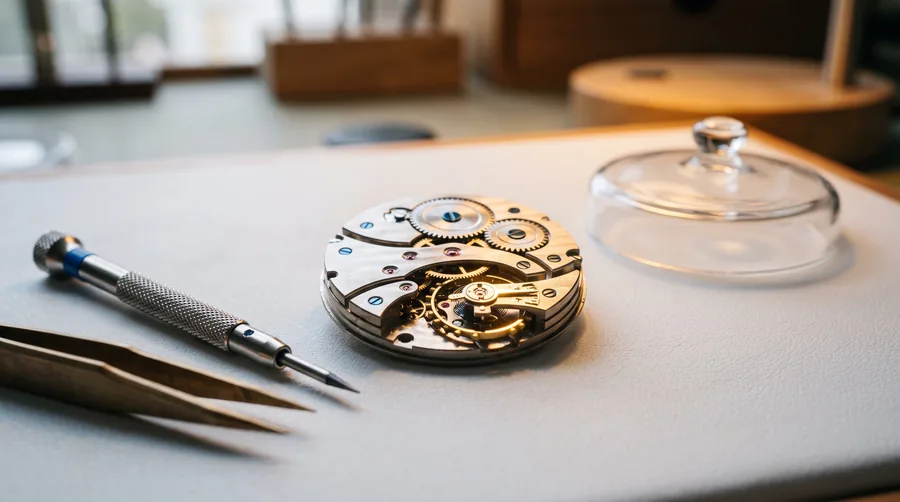
Complete disassembly of the movement to individual components. Ultrasonic cleaning of every part. Inspection for wear, particularly at the pivots and the escapement. Replacement of any worn component and always of the gaskets. Fresh lubrication with several different oils and greases at specific points, applied in quantities that require a microscope. Reassembly, regulation in multiple positions over several days, and pressure testing of the case.
That is a full day of skilled work at minimum, and considerably more on a chronograph. Understood that way, the prices are not outrageous. They are simply invisible until they arrive.
The real numbers
- Simple three hand automatic, common movement, good independent watchmaker: 350 to 600.
- The same watch at the brand service centre: 600 to 900, with a cosmetic refinish included whether you wanted it or not.
- Chronograph: 900 to 1,500 independent, 1,200 to 2,000 at the brand.
- Perpetual calendar, minute repeater or anything with a house complication: 2,000 upward, and a wait measured in months.
- Quartz: a battery every two to five years at 15 to 60, and a full service almost never.
The interval argument
Brands say five years. Watchmakers frequently say seven to ten if the watch is running well and keeping time. Both are defensible. Modern synthetic lubricants are far more stable than the natural oils they replaced and do not degrade on the old schedule, but they do migrate away from the surfaces they are meant to protect, and a dry pivot wears metal in a way that a service cannot undo.
The practical compromise is to have the watch measured rather than serviced on a calendar. A timing check on a machine costs little or nothing and shows amplitude, which is how far the balance swings. Falling amplitude is the early sign of dried lubricant, and it shows up long before the watch starts keeping poor time. Service on the amplitude, not on the anniversary.
A watch that has lost amplitude is wearing itself out in silence. It will still be keeping good time while it does it.
Brand or independent
The brand has the parts, the specification and the ability to guarantee the work. It will also often replace components as a matter of policy rather than necessity, and will frequently polish the case unless explicitly told not to, which on a vintage or a sharply finished watch destroys value and cannot be undone.
A good independent watchmaker is usually cheaper, faster, will keep original parts and will do exactly what you ask. The constraint is parts availability, since several large brands now restrict supply to their own network, which is a commercial decision presented as a quality one.
Two instructions, given in writing, save the most grief: do not polish the case, and return any replaced parts with the watch.
Putting it into the purchase
A watch at 4,000 with three services across twenty years at 800 each has a true twenty year cost of 6,400. One at 12,000 with a house movement, serviced three times at 1,600, costs 16,800. Both figures are knowable on the day of purchase, and neither appears on the price tag. Add the service line to the decision and some watches become considerably more attractive than their sticker suggests, and some considerably less.
Spotted an error? Tell the desk