Fashion
The only number that decides whether a coat was expensive
Price is what you hand over once. Cost is what the thing takes from you every time you wear it, and the two rarely agree.
4 min read · 12 September 2026
Cloth, cut and the arithmetic of a wardrobe
Fibre before label, cut before season, and the only number that decides whether a garment was expensive: the price divided by the number of times you wore it.
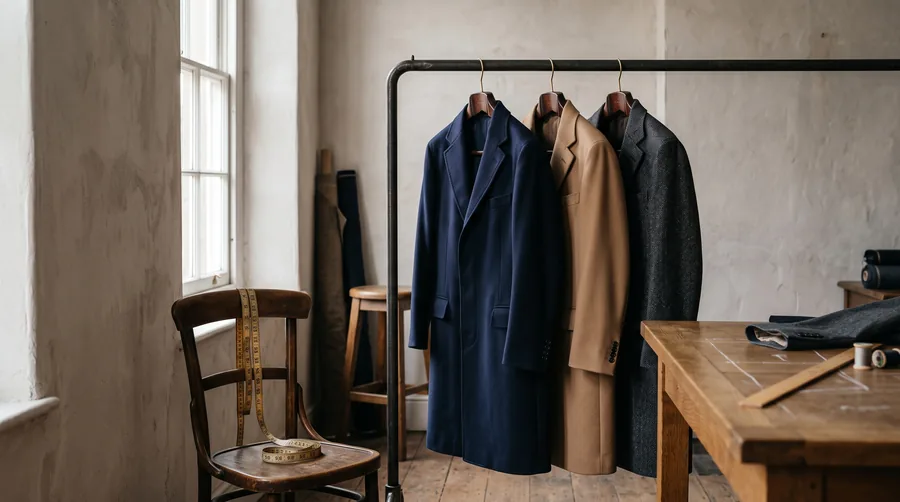
Most of what separates a good garment from an ordinary one is decided before anyone designs it. A fibre is chosen, with a diameter measured in microns and a staple length measured in millimetres. A yarn is spun tight or soft. A cloth is woven at a given weight and finished, or over-finished, to feel expensive in the hand for exactly as long as it takes to get it home. None of this appears on the label, and all of it decides how the thing will look in year three.
The second half is fit, which is not the same as size. A jacket is right when the collar sits on the shirt without a gap, the shoulder ends where yours does and the sleeve shows a centimetre of cuff. Those three points can be bought off a rail or corrected by a tailor for the price of a good dinner, and no amount of money spent on the label will substitute for them.
The third half, if we are allowed one, is arithmetic. A wardrobe is a portfolio: a small number of pieces carrying most of the wearings, a long tail carrying almost none. The desk publishes the cost per wear because it is the only figure that tells you which half of the portfolio you are about to add to.
6 pieces
Fashion
Price is what you hand over once. Cost is what the thing takes from you every time you wear it, and the two rarely agree.
4 min read · 12 September 2026
Fashion
The word on the label is regulated. Everything that decides how the knit will look in year three is not, and three of the four tests are done with your hands.
3 min read · 11 September 2026
Fashion
Fit is not size. Three measurements decide whether a jacket looks expensive, and only one of them is difficult to change.
3 min read · 10 September 2026
Fashion
A capsule is not an aesthetic, it is a combinatorial problem. Solve it properly and a small wardrobe produces more outfits than a large one.
3 min read · 9 September 2026
Fashion
Stripping the logo off a garment does not change the garment. What the phrase got right, and what it was used to sell.
3 min read · 8 September 2026
Fashion
Wear is near the bottom of the list. Heat, friction, solvent and hangers do most of the damage, and all four are avoidable.
3 min read · 7 September 2026
The desk asks
Instruments
The Atelier
Yes, but not reliably by price. What changes the hand and the life of a knit is fibre diameter, staple length and ply. A two ply knit at 15 microns with a 36 mm staple will outlast a single ply at 17 microns by years, and both can appear at either end of the price list. The material file sets out how to check it in a shop.
Sleeve shortening on a jacket from the cuff runs roughly 40 to 80, from the shoulder two to three times that. Taking in a waist is 40 to 70, a trouser hem 15 to 30. If a garment needs more than three alterations, it is the wrong garment.
A heavy wool overcoat worn through five winter months, three days a week, reaches about sixty wearings a year. Ten years of that is six hundred, and the cloth will not be the thing that fails: the lining and the pocket bags will, and both are replaceable for a fraction of the price.
Over-cleaning does. Wool and cashmere need cleaning once or twice a season at most, and airing between wearings does more for them than solvent. Sweat and food need immediate attention, dust does not.
The Friday file
A short letter on Fridays: a single material examined, the arithmetic behind a purchase people get wrong, and the one line from the week worth keeping. No offers, because there is nothing to sell.